Showing posts with label the great book liberation project. Show all posts

Tuesday, April 29, 2014

The Color Purple by Alice Walker (18 of 166)

One Sentence Summary: Celie, an impoverished black woman living an agonizing cycle of abuse and oppression, comes to find her inner light enabled and bolstered through the course of her life by the people and events that come through it.

Excerpt
“I think it pisses God off if you walk by the color purple in a field somewhere and don't notice it. People think pleasing God is all God cares about. But any fool living in the world can see it always trying to please us back.” 
I actually can't believe it took me this long to read this book. It's another major school reading list champion and I guess I always avoided those- I was going to be forced to read them eventually, so why go out of my way? That was probably the thinking. Foolish, of course. Most of the books on those reading lists are on there for a reason.

From a writing perspective, Alice Walker is unreal. Her ability to write dialect and ignorance and perspective is so inspiring, it makes me want to write my butt off. I love how, with this particular craft, simply reading is perhaps the best way to learn from the masters. I feel as if my life is overflowing with the power of the two incredible women I have only just now been exposed to- Toni Morrison and Ms. Walker. They are separate entities, with strong individual identities, but their joy for life is so completely unbridled and seeping through the cracks of their work, that I will think of them together always. I cannot relate to many things in their books, particularly the American black experience, not directly, anyway, but I am learning learning learning. Even struggling to comprehend that element, I feel as if I am leaning on their formidable shoulders. 

When it comes The Color Purple specifically, I am just in awe of Celie. The characters are so believable and vivid- but all come to being beneath Celie's forgiving and increasingly wise gaze. Growing with her is a privilege. You find yourself wanting to weep tears of joy as she comes into her own and grasps life and takes a hold of her future and discovers the unquenchable thirst of her spirit. At first I thought that I was meant to love Shug for bringing the wrecking ball into Celie's constructs of self-defense mechanisms, but then I realized it was Celie gently teaching everyone, even as she learned. There is so much pain in this book; the first few chapters are even a little exhausting in the scope of their abuse and hardship, but it sets the stage for a story about hope that must be among the greatest ever written.

 Life is hard, chickens, but the light is just a few steps further, always.  You can take that away, no matter what your race or history, because everyone has felt pain, been betrayed, and stood alone in the darkness sometime. Their tales remind me of how our lives do not run parallel to those of others- how instead, we wind and weave through the narratives of friends, families, and enemies alike. In that way, the tapestry becomes strong- wind and weave, wind and weave.

Shelf Status: Moving Along and someday buying a copy with the binding attached
If You Liked The Color Purple you may like: Beloved , The Invisible Man, All Over but the Shoutin', The Immortal Life of Henrietta Lacks

Monday, April 14, 2014

Beloved by Toni Morrison (16 of 166)

One Sentence Summary: The dark presence that pursues an ex-slave woman and her family creates a maelstrom of heartache and memory in its vengeful wake.

Excerpt:
“There is a loneliness that can be rocked. Arms crossed, knees drawn up, holding, holding on, this motion, unlike a ship's, smooths and contains the rocker. It's an inside kind--wrapped tight like skin. Then there is the loneliness that roams. No rocking can hold it down. It is alive. On its own. A dry and spreading thing that makes the sound of one's own feet going seem to come from a far-off place.” 
This is a long overdue read. I paid it little mind when it appeared on reading lists in high school as an option- I was far more concerned with reading fat classics with intimidating reputations than this slender volume and its unapproachable subject. A copy found its way into my hands, and that copy into a dark corner of my closet, and there it sat and waited and waited, as so many books have done all of these years. Well, today I finally sat down with it and I read... and read... and read. I read for hours. My heart is sore. My eyes are tired. I feel a little shaky and out of sorts, because I have spent so much time, a small lifetime, on this couch, having this book move through my insides and take up roost in my heart and soul. I could not turn away from the agony and memory of these characters, now so much a part of my life, and the real world seems foggy in that special unreality that comes only from surfacing from the deep waters of a text with no bottom.

Toni Morrison writes about heartache and evil and simple goodness and pain and jealousy and need and want in ways that I have never encountered. She speaks straight to the heart of all that is fragile and secret in the heart of a person, but particularly of a woman. The reader feels keenly the shame of Sethe's life, of living in a world that can do such things, strike such fear of living, into a human being. The story comes out, a long red thread, ducking and weaving through the non-linear telling, and it is a dark flower blooming slowly. Morrison's work is switchblade poetry, deceptively beautiful and raw. Lulled by the language, you are all of a sudden locked in the simmering microcosm of 124 with its unfortunate denizens- flawed, desperate Denver, regal and shattered Sethe, blessed Paul D, Baby Suggs, holy, and Beloved- the gentle to heavy pressure of Beloved, always, haunting the house. Once again, I am reminded that the great ghost of the sins of this world bears the face of a child. 

Learning about slavery in school, there is and always will be a certain amount of separation. A detailing of the atrocities may make you pause for a day, but this book is the photograph that takes up residence behind your eyes. I once saw a black and white picture of a box of wedding rings removed from the hands of Holocaust victims. That box was so deep and wide and full and it is part of the catalog of my finite experience that informs my world view. Here we see straight into the aftershocks of humans treated as animals, denied themselves, and it is so painful and so necessary because this work of fiction, like most, walks the well-beaten paths of reality. Beloved demonstrates the power of literature simply by being- this is what a book can be: a sword and a trigger.

I will never forget these characters and what they represent. Beloved comes into your house and unless you will yourself to forget her, she never really leaves.

Shelf Status: Keeping
You May Enjoy Beloved if you enjoy: The Invisible Man, East of Eden, Night

The White Tiger by Aravind Adiga (15 of 166)

One Sentence Summary: Balram Halwai, hailing from one of many (any) villages in the great swath of neglected rural India, becomes the first driver to the son of a coal magnate and, desperate for real opportunity, murders him.

Excerpt:
“Go to Old Delhi,and look at the way they keep chickens there in the market. Hundred of pale hens and brightly colored roosters, stuffed tightly into wire-mesh cages. They see the organs of their brothers lying around them.They know they are next, yet they cannot rebel. They do not try to get out of the coop. The very same thing is done with humans in this country.” 
I spent six months in India last year and am still processing the experience. The White Tiger is disturbing, but even more disturbing when you know how frank and completely possible it is. Spending time in the head of Balram Halwai, you could be in the head of any number of individuals whose lives are placed in the careful boxes of caste and class. The more you think about it, the less solid any ground becomes. While this book is most definitely a tale that seeks to pull back the veil from modern India specifically, it also makes simple, human observations that extend to the infrastructure of any nation where class designation makes us see each other as less or "more than".  Being in Balram's head made me a bit queasy because, while he is certainly corrupt and ultimately wicked, you can see how he became that way and it is very hard to blame him completely. You sympathize with him and you don't want to, but you must.

Adiga's narrative is sharp and quick and I would have been disappointed had it not been, as it did bring home the Man Booker Prize in 2008. Because of this fluid and accessible writing style, the whole book gives off the feeling of a car crash that you are watching take place, complete with the little building scream at the back of your head. The author's choice to let us in on Halwai's trespass right at the beginning of the story sets up the entire story for a feeling of momentum so intense that you almost want to jump and roll off the train. He pulls no punches in confronting the reader with a harsh underworld that is chaotic and of a darkness that feels well-like, but seems to avoid blatant exaggeration. That being said, I read one review that said that The White Tiger was not a work of literature, but a collection of facts. That puts words to what I was trying to articulate throughout reading. While I do not completely agree with the claim that it is not literature, I also sometimes spotted the profusion of information, it betrayed itself by becoming significant to the point of being noticeable- still, I think it a small price to pay for the level of immersion that Adiga creates. You get all the way to say, the seventh circle of Delhi. Certainly, sometimes this book can come across a bit of a crash course- but I stick to my guns when I say that it ultimately avoids the dreaded feeling of "information dump".

This is one that I would like to abstain from "rating", per se. How would I go about rating it? Did I enjoy it. No, not really. I was glad to finish it, but also glad for having read it. Did I think it was significant and important and worth reading? Oh yes, definitely. On a more personal level, I may never completely understand the unrest that still comes upon my soul when I think of India, but reading brings me closer and I think that this book tapped into that need for me. Still, it is heavy and if you are seeking a happy-go-lucky guru road trip tale, this is not going to be it.

I am now off to go read more heavy literature because I said so in my last post. I think that after Beloved, The Color Purple, and Snow Falling on Cedars, I will be ready for Harry Potter and the Order of the Phoenix- really, really ready.

Thanks, Hannah South, for the recommendation!

Shelf Status: Off to a book tarp in Connaught Place
You May Enjoy The White Tiger if you enjoy: The Invisible Man (Ellison, not Wells), Interpreter of Maladies

Thursday, April 10, 2014

In Which I Take a Buzzfeed Quiz and Hit the Library Book Sale

I took a Buzzfeed Quiz and I'm not ashamed because it was on one of my favorite subjects: banned books! You should take it, too, and then we can compare geeky notes.

http://www.buzzfeed.com/ariannarebolini/how-scandalous-is-your-reading-history

I've read 47 of 93 of the banned books on their list, which means two things:

1. I have a moderately scandalous bookish history- more easily compared to the track record of Zelda Fitzgerald than that of Tallulah Bankhead.


"Scott does worry so over
 my troublesome spells..."
If I smoked one cigarette for each of the scandals of the day,
Hollywood would have a cigarette shortage.

 2. I have to step up my game!

There were several books on the list that I have been intending to read and three of them were even on my list for The Great Book Liberation Project (explained at the end of the link rainbow)!
1. Beloved by Toni Morrison
2. The Color Purple by Alice Walker
3. Snow Falling on Cedars by David Guterson
I am going to pick up a cheapo copy of 1984 tomorrow so that I can add it to my project. It may shock you, as it certainly shocks me, that I haven't read it- but when I first tried there was sex and I got a little fit of the vapors because that was my knee jerk reaction to any mention of sex for a very long time while growing up. So let's say,
4. 1984 by George Orwell
Those four books will be my next four reads in the project, methinks. I am currently reading White Tiger.

I also purchased four books at the library book sale and one book while I was out tonight. Please don't look at me.


This project is never going to end, is it?


In other news, I heard peepers as I drove home this evening and finished my route with an absurd grin on my face. Spring is officially here and not going anywhere. 
If you don't have peepers in your life, I am so sorry. Here is an explanation of what they are.
Here are 10 continuous hours of what you're missing out on.

Captains Courageous by Rudyard Kipling (14 of 159)

Book covers of this type always make me wonder
 if they were painting from wooden models
One-Sentence Summary: The insufferably spoiled Harvey Cheyne topples off of his cruise-liner and into the lives of his rough fishermen saviors, only to be transformed by the manly virtue of their craft.

Excerpt:
“It was the forty-fathom slumber that clears the soul and eye and heart, and sends you to breakfast ravening. They emptied a big tin dish of juicy fragments of fish- the blood-ends the cook had collected overnight. They cleaned up the plates and pans of the elder mess, who were out fishing, sliced pork for the midday meal, swabbed down the foc'sle, filled the lamps, drew coal and water for the cook, an investigated the fore-hold, where the boat's stores were stacked. It was another perfect day - soft, mild and clear; and Harvey breathed to the very bottom of his lungs.” 

Teddy Roosevelt was probably all over this book. It was definitely designed to be read by people like this:
Ten bucks says that backdrop is painted.
Not that this was an uncommon audience. Kipling wrote in a time when men were men and boys beat each other up over damaging repressed emotions and daddy issues (but valiantly). I'm not saying there is anything wrong with the turn of the century's boy adventure story genre. One has to be sensitive to the times in which they were written- but Captains Courageous is a whole 'nother story. Robert Louis Stevenson was a contemporary of Kipling's, and while I would have loved to put them in one room to have it out over the treatment of island natives, let's focus on a comparison of their literary work. Where I find that Treasure Island reads as a pure adventure story, Captains Courageous can come across as a bit heavy-handed. Harvey begins the story by being characterized as effeminate and spoiled, a spiney little mother's boy who generally drives others mad with his demanding behavior. He ends it as the ideal son- quiet, composed, just in ways both economical and moral, and smelling ripely of cod. It's a little too clear cut of a moral taleI was glad to say that Harvey was not impervious to weakness- Kipling may have seen Harvey going the way of the flawless convert and so throws in a fainting spell for good measure. Good work, Rudyard. Crisis averted. More than anything, this is just a reminder to take moral character tales of the time with a grain of salt. Or, you know, a whole ocean of it.

I don't want you to think that I didn't enjoy Captains Courageous. I am a huge geek for good naval yarns and history. I like to stand waste-deep in boat jargon and sit down to cramped dinners with swarthy mixed bags of callused crew. As a matter of a fact, reading this instilled in me the strong desire to re-read Moby Dick and In the Heart of the Sea, simultaneously. Good thing Melville's White Jacket is on my shelf, just waiting for its turn in The Great Book Liberation Project. I'm an ocean girl and I always have been. There may be a bit of the selkie in me yet. Kipling captured my favorite elements of the sea story with passion and precision- the fresh air, the colors of the Atlantic, the sense of unbridled curiosity for a secretive and ancient force. I actually stayed up until 12:30, totally immersed in the very satisfying conclusion of the little story. I don't know if Captain's Courageous is as deep as its main subject, but it is still fun and full of little jewels of description and character. 

Shelf Status: Being released to the great and bounding main
You May Enjoy Captains Courageous If You Enjoyed: Moby Dick, Treasure Island, In the Heart of the Sea

Friday, April 4, 2014

The Golden Apples of the Sun by Ray Bradbury (13 of 159)

One Sentence Summary: A collection of Ray Bradbury's short stories spanning topics as curious and varied as time travel, life on Mars, and the summer lives of growing boys.

Excerpt:
'Mr. Douglas,' says the night watchman, 'did you ever read that story about the man who traveled to the future and found everyone there insane? Everyone. But since they were all insane they didn't know they were insane. They  all acted alike and so they thought themselves normal. And since our hero was the only sane one among them, he was abnormal; therefore, he was the insane one. To them, at least. Yes, Mr. Douglas, insanity is relative. It depends on who has who locked in what cage.'
-from The Meadow
I know that Ray Bradbury is considered classic, but even so I think that's not enough praise. In my opinion, he attains that level of storyteller that taps into one of the most important fields of potential for the craft- prophecy. Bradbury's ability to observe human behavior and see where it could possibly lead is almost unnerving. The Murderer is all well and good as a warning against over-socialization and the dangers of social media and constant interaction and bears startling similarities to the modern age, but when you consider that it was written in 1953, it gains a new dimension. Huxley, Orwell, and Bradbury- damn, but they knew what was up before we (my generation) were even born.

I started reading Bradbury with Something Wicked This Way Comes. For years, I would try and fail to read that book because its tone really did something to my head. It was frightening and unsettling in a way that no other book I had ever read was and every October I would take it out from the library and try again. I could not put a finger on why it struck a chord with me where other spooky tales failed, but now I understand it was Bradbury's mastery of atmosphere. When I was finally mature enough to absorb and process it, it became (and remains) one of my favorite books.

Bradbury's descriptions fill in the blank spaces in the world- his imagery taps into a minute internal seed where instinct and truth meet. The way he describes a summer's day or sculpts an entire short story around the complex and deeply stored emotion of loneliness is incredible. It may sound strange, but something within the reader responds to something in the writing. I cannot help but think that the monster in The Foghorn is perhaps the most accurate metaphor for how it feels- an old sort of thinking pulls itself up from your very core and cries, cries, back at the resounding promises in this work. Bradbury reconnects me with my sense of wonder, my desire to set out into the universe and uncover its secrets, and that is why I simply can't stop reading him. His stories are almost infallibly exciting and I always feel exhilarated when I come away from them.  His words on writing and reading remain a constant guide and are perhaps the most accurate words for describing how I feel about my life in words:

“You must write every single day of your life... You must lurk in libraries and climb the stacks like ladders to sniff books like perfumes and wear books like hats upon your crazy heads... may you be in love every day for the next 20,000 days. And out of that love, remake a world.”

Again, I almost always encourage reading anthologies as a full unit, but the pieces that most got to me from The Golden Apples of the Sun were:

The Fog Horn
The Murderer
The Meadow
R is for Rocket
The Great Fire
A Sound of Thunder
The Long Rain
The Dragon

Hmmm, I meant for that to be a shorter list. I guess I couldn't help myself.


Shelf Status: Keeping Forever
I Recommend For: Sci-Fi Buffs, folks feeling out of touch with joy and wonder, writers
I Do Not Recommend For: People who don't do lengthy description

Monday, March 31, 2014

Three Cups of Tea by Greg Mortenson & David Oliver Relin (12 of 159)

One Sentence Summary: The story of Greg Mortenson and his life's work of building schools in the war-torn Middle East as vehicles for peace.

Excerpt
'Osama, bahh!' Bashir roared. 'Osama is not a product of Pakistan or Afghanistan. He is a creation of America. Thanks to America, Osama is in every home. As a military man, I know you can never fight and win against someone who can shoot at you once and then run off and hide while you have to remain eternally on guard. You have to attack the source of your enemy's strength. In America's case, that's not Osama or Saddam or anyone else. The enemy is ignorance. The only way to defeat it is to build relationships with these people, to draw them into the modern world with education and business. Otherwise the fight will go on forever.'

This time last year I was looking toward wrapping up my time volunteering for an organization in Pune, India that was striving to create a safe environment for the nursery-aged children of one of the city's poorest neighborhoods to learn and grow. I will not expound on why, but I came away feeling as if I had failed in many directions. A year out, I am beginning to view my failures and shortcomings as unique opportunities to push myself to excel in the future, but my awareness surrounding all that I could and should have done better still rubs raw. For all of that, I learned an enormous amount, much of which I have only come to realize in the many months since my return, and I continue to process and understand more about my experience as time goes by. Three Cups of Tea spoke to that fire in me, acquired in India and Nepal, where I came to view education as empowerment and as freedom.

While I didn't love the book so much, it wore on me for so many reasons, I would still recommend it. Some non-fiction is simply worth reading, even if the writing isn't so hot. Mortenson's book is important because it reminds the reader to reset a little bit and shake up the propaganda ridden way that we have come to think of the Middle East. I think it could have done a little more in this respect, had it stepped away from the hardcore hero-worship, but ah well. My heart ached reading this as I thought of the carelessness with which promises have been made to that region of the world, on individual, community, and national levels, and how those breaches of contract have compromised everyone involved. The highest compliment that I have for Mortenson, if the facts are as the book puts them forward, is that he kept his word and created bonds of trust on the individual level that he refused to break.  Also, his adaptation to the culture is to be praised. Cultural imperialism is a major danger when attempting to bring aid to any disenfranchised area and he appeared to avoid that most admirably.

This book is a wonderful conversation starter- I would imagine it to be perfect for high school classrooms or community book clubs. That being said, I also tend to think Three Cups of Tea oversimplifies some issues facing the Middle East, particularly those surrounding American involvement. BOOM. Discuss. Either way, I came away reminded of how much can be done with the most basic of human entitlements, education, and also affirmed in the fact that I have a whole lifetime in which to help plant stronger seeds.

Shelf Status: Donating
I Recommend For: Social justice folks, people interested with current events, teachers, students
I Do Not Recommend This For: Glenn Beck

Monday, March 24, 2014

Dr Jekyll and Mr Hyde and Other Stories by Robert Louis Stevenson (11 of of 159)

One Sentence Summary:
 1) The dignified Mr Utterson investigates the mysterious connection between his friend, the esteemed Dr. Jekyll and his new, grotesque paramour, Mr. Hyde.
2) The trader Wiltshire arrives at his new station to find the goings-on of the island being manipulated by the conniving Mr. Case.
3) Three ne'er-do-wells of varying morality set out to improve their fortunes and end up invariably worsening them. 

Quote (from the dedication):
It's ill to loose the bands that God decreed to bind;
Still will we be the children of the heather and the wind;
Far away from home, O it's still for you and me
That the broom is blowing bonnie in the north countrie.

The dedication feels like the correct thing to include because there is a reason that Stevenson chose to include that little verse. What follows are more or less morality tales which dabble in some seriously major questions: is there any such thing as absolute morality? Do we endanger ourselves by completely denying our inherent darkness? Is a person with no dimensions or conflicts of conscience even a person at all?

Dr. Jekyll and Mr. Hyde was a great tale, just as I'd hoped, and definitely one that you think you know, but probably do not. There have been so many iterations of the story in pop culture that it has strayed from the root- this wonderful, lengthy short story. Stevenson has a great appreciation of tone and it is consistently his portrayal of a dank, mist-suffused London that give you the shivers. It is not difficult to imagine yourself alongside Utterson on a midnight amble to track down the deplorable Hyde. You can feel Stevenson's personal conflict surging beneath the surface of this story. I have to wonder how much of himself he saw in the fallible, mostly well-intentioned Jekyll and how much that writing this took out of him.

I wasn't terribly fond of the second story. Certain unlikeable characters can be survived for the sake of the story, but I didn't feel powerfully compelled enough by the plot to get over how obnoxious Wiltshire was. 

I was feeling a bit downtrodden by the time that I reached the third story, but it sucked me in- perhaps even more so than Jekyll and Hyde. My heart went out to Herrick, a hapless sort who has never applied himself enough to anything to amount to much. His moral compass is still in there, harkening to North, if weakly. Then there is Davis, pursued by his personal demons of failure and yet unwilling to adjust the habits and mentality that led him there in the first place. And, of course, Huish, the human leech. Setting the three together on their common course begins a game of the moral, immoral, and amoral that reaches its climax on the island of a dapper tyrant who is a dizzying combination of the three. The action moves along at a clip and it seems as if Stevenson found, in The Ebb-Tide, a way to combine his more exalted literary inclinations with his natural penchant for adventure tales. I wish it were a more famous work- it has the power to be a more fitting legacy.

Reading these three stories, so far from the clear-cut good and evil adventure tale of Treasure Island makes me wonder if Stevenson was feeling pigeon-holed in his career by his reputation for "ripping good reads". I think differently of him now, though, as a literary force in his own right, instead of merely a talented man with the imagination of a naughty boy.

"You must suffer me to go my own dark way."
- The Strange Case of Dr. Jekyll and Mr. Hyde

Note: I could not finish The Dance of the Dissident Daughter, which makes this eleven, instead of ten.

Wednesday, March 19, 2014

Night by Elie Wiesel (9 of 156)

One Sentence Summary: Elie Wiesel's autobiographical account of his experiences during the Holocaust.

Excerpt
“Never shall I forget that night, the first night in camp, which has turned my life into one long night, seven times cursed and seven times sealed....Never shall I forget those moments which murdered my God and my soul and turned my dreams to dust. Never shall I forget these things, even if I am condemned to live as long as God Himself. Never.” 
I read horror novels and thrillers regularly and if I have learned anything in the process it is that they cannot measure up against non-fiction. As soon as the human race imagines something more terrible than previously known they put it into practice and so history stretches on as a long legend of repeated ills. Elie Wiesel's story is more than a sickeningly bald-faced first-hand account of the Jewish nation's struggles in the Holocaust, it is a mirror and a warning. We are capable of anything, he reminds, on either end of the spectrum- no living thing can survive like a man and nor can anything parallel man's ability to destroy.

There is little to say aside from the fact that this is a necessary volume, slim and thoroughly haunting and an agony to absorb. I laid in bed and the phantoms gathered in the sea of darkness beyond my mattress and I was so very, very sorry.

There is really nothing more to say.

Friday, March 14, 2014

Dubliners by James Joyce (8 of 153)

One-Sentence Summary: James Joyce outlines the moral landscape of his beloved city of Dublin in a series
of short stories spanning every social class in the early part of the 20th century.

First Lines (from Two Gallants):
"The grey warm evening of August had descended upon the city and a mild warm air, a memory of summer, circulated in the streets. The streets, shuttered for the repose of Sunday, swarmed with a gaily coloured crowd. Like illumined pearls the lamps shone from the summits of their tall poles upon the living texture below which, changing shape and hue unceasingly, sent up into the warm grey evening air an unchanging unceasing murmur."
This copy of Dubliners was given to me by the mother of a high-school boyfriend, years and years ago, with very few words. She simply knew that I would like it and she was a warm and thoughtful human being and, years later, I have finally got around to reading all of it and realized what a gift she had given me.

James Joyce writes a different sort of short story than I am used to. I am accustomed to a clear trajectory, a line that is straight from Point A to Point B, all things leading to a clear and concise climax and denouement, all things between informing the end. That is not how the stories in Dubliners unfold. In each is the whole world, and the plots often run still and deep so that the characters and their city can move to the front. Joyce is often a bit of brain work, but it is refreshing to read something critically for symbolism and depth again. I remember reading Araby in high-school for a class and feeling like I had my eyes opened to something. Joyce has that effect.

I don't think it necessary to pontificate on the wonder that is Joyce. There are plenty who could do a far better job at that than I. Still, I hope this is a safe space to say, I found a little humor in reading A Painful Case and The Dead and seeing a bit of the narrator's mind when it came to the elite and the hyper-educated. I think you can guess why I saw the irony in that. Joyce could have written himself into any great intellectual parlor in the land had he meditated on different themes, but he chose to reveal the moral underpinnings of the society from which he came instead. Little has changed in societies, in general. The meditations remain the same: religion, family, love, duty, class, injustice, on and on. The nature of his focus ensures that there is something that remains extremely relevant about Joyce's work.

While Dubliners is technically a short story collection, I think I benefited hugely from reading it as a single entity. There is a flow to the passions when read front to back, from ecstasy to despondency, courage to fear. From disillusioned youth to optimistic age and on and on, expertly ordered and woven. Still, I had my favorites, the ones that struck me most, for this reason or that. They were, and I sure this will change upon re-reading:
Eveline
Two Gallants
Clay
A Painful Case (ouch. ouch. ouch.)
A Mother (I swear, I have met Mrs Kearney)
The Dead

I am trying to purpose to read more short story collections. I fancy myself more naturally bent towards long-form fiction, but I don't really know how true that is. And, as any artist can tell you, it's wise to play with different mediums and not to limit yourself too much. I always think myself incapable of writing short stories until I am reading them. While reading Joyce is almost intimidating, it also reminds me of what the craft can be, what it can reflect, and what it can preserve.

Tuesday, March 11, 2014

Congo by Michael Crichton (7 of 153)

One-Sentence Summary: An astonishingly thick band of supposedly smart people heads into the darkest, most forbidden corner of the Congo in the wake of the mysterious obliteration of a prior expedition.

Subtitle: Don't Do the Thing. Just Don't Do the... You Did the Thing.

First Lines (from the Introduction):
"Only prejudice, and a trick of the Mercator projection, prevents us from recognizing the enormity of the African continent. Covering nearly twelve million square miles, Africa is almost as large as North America and Europe combined. It is nearly twice the size of South America. As we mistake its dimensions, we also mistakes its essential nature: the Dark Continent is mostly hot desert and open grassy plains."
I was first introduced to Crichton on the butt-numbingly hard floor of my eighth grade classroom, where my small class gathered each day after lunch to read from The Andromeda Strain. That teacher was magic, a woman who could make a math class into something that you actually regretted ending and she wove the same sort of trickery into her reading of Crichton. She made it the  best book in the world, concentrating all of her wonky and fantastic energy into making it a story that we couldn't wait for each day, and man oh man, did she succeed. I don't know if Crichton will ever possess the same sort of magic for me again. Maybe it was an experience that rested in her or maybe, maybe Congo was just a miss for him.

This book drove me crazy. The smartest character is Amy, the gorilla- closely followed by the jungle desperado type, Munro, who is indisputably crazy-pants. Anyone else who is supposed to possess a scrap of plausibility or intelligence or believable emotional responses, is actually a cardboard cut-out that topples over somewhere in the third act. Seriously though, Karen Ross? I couldn't believe her being there for so much as a second and when she literally SPOILER blew up a mountain SPOILER  in the finale, I just plain gave up. But let's be honest with ourselves. Does anyone read Crichton for his sterling character development or for a logical plot? Absolutely not. We read Crichton to be entertained and there isn't a thing wrong with that. Congo is the battered paperback copy that you bring to the beach. It sunburns your soul while you sunburn your everything else. It's absurd and even a little insulting, but I'll be damned if I could stop reading it. I was awake at four o'clock this morning, watching plot bunnies disappear into the undergrowth at previously unrecorded levels, and I was enjoying every second of it.  The LA Times review featured on the front of my copy screamed its recommendation, which stated, and I quote, "An old fashioned thriller-diller...". We can't exactly be placing too many exalted literary expectations on something referred to as a thriller-diller.

Even dumping mercy on this, I still can't forgive it its most egregious plot trenches. Beyond the basic set-up, which was appealing: a mysterious stone-hewn city, animal behavior, a conniving stone-cold fox, and a hapless laboratory stooge, there is a lot to work with there. Add on volcanoes, diamonds, gorilla kidnappings, cannibals, raging tribal warfare, suspicious pygmies, hippo attacks, and a Melville-esque train of possibly made-up field science jargon, and it starts to feel like maybe you're on an underground Disney ride with Bill Nye.  Even a thriller-diller can, and should, have some substance and, as anyone who has seen a Fast and Furious film will tell you, explosions alone can't fill that little hole in your chest that is dreaming of quality. That being said, Crichton is really very good at explosions.

I Recommend This For: intelligent apes, fans of Jurassic Park, Crocodile Dundee
I Do Not Recommend This For: Book elitists, fact-checkers, Sticks-in-the-mud

Thursday, February 27, 2014

The Little Prince by Antoine de Saint-Exupery (6 of 147)

One-Sentence Summary: A children's book and framework tale in which a little prince shares the story of his journey with a downed fighter pilot in the African desert. 

Subtitle: Feels You Didn't Know You Had

Excerpt:
"Goodbye," said the fox. "Here is my secret. It's quite simple: One sees clearly only with the heart. Anything essential is invisible to the eyes."
My incredible boyfriend gave this to me for a Christmas gift, along with a $10 gift certificate to an antiquarian bookstore with a $5 admittance fee, and my own film camera. I'm always telling him to read things and as he despairs beneath a pile of to-be-reads from which, at this point, he could easily construct a book igloo, it is the rare and exciting moment that comes along when he can tell me to read something I've never read before. Because he is not six years old, he stops just short of leaping up and crying "A-HA" when the words "I've never read it" fall from my mouth, but just. The reaction was different with The Little Prince, though. It came up in conversation and he seemed truly struck and even disheartened that I'd never been exposed to it before. Months after that initial conversation had passed into forgetfulness, I opened my Christmas gift to find my very own copy. For me, there is no love like the sharing of a story that is close to your heart. It is a jewelry box, lying open, waiting to be plundered, hoping that its pieces are instead loved and respected. Reading The Little Prince was beautiful two-fold. First, it was a wonderful, wonderful story that I am so glad to now have in my heart and mind- Second, it was a reminder that the young man who loves me is full of a rare and wonderful light, and I am so very lucky to have it brighten my life.
"And I realized I couldn't bear the thought of never hearing that laugh again. For me it was like a spring of fresh water in the desert..."
 ---
"People have forgotten this truth," the fox said. "But you mustn't forget it. You become responsible forever for what you've tamed. You're responsible for your rose.""I'm responsible for my rose..." the little prince repeated, in order to remember.
This is the story to tell in dark times. De Saint-Exupery, the man who wrote it, was a French fighter pilot in World War II, who died only a year after the publication of The Little Prince, which was his master work. On the phone last night, the boyfriend and I got into speaking about it when I called to thank him for what was potentially the loveliest Christmas gift I have ever received. Exupery brought me back to Roald Dahl, a much beloved writer of similar background. These two men had both seen incredible darkness by the time they came to the table to write their most loveliest stories. They had seen blood and death and skies on fire, but it remained that those experiences were not the most important thing they shared. "How did they protect the wellspring from where such child-like wonder and goodness flowed," we asked ourselves.

 It occurred to us both, even upon wondering, that it was perhaps their defense against the vicious world gone mad, that their exposure to great darkness allowed them to recognize those things that truly generate great light: the love of the Buckets in Charlie and the Chocolate Factory, the friendship of The BFG, the gentle care of the volcanoes and rose in The Little Prince, and so on and so forth. In a very complicated world, they detected what was vital in the landscape and found that the components of happiness were very simple indeed.

I look forward to having the opportunity to share this book with individuals both young and old that come across my path in the future. Its relevance is timeless. Best described as pure, The Little Prince does nothing if not reignite in the reader their sense of wonder.

I Recommend This For: Human Beings
New Goal: Read this in French


Wednesday, February 26, 2014

Rebecca by Daphne Du Maurier (5 of 147)

One Sentence Summary: An awkward, innocent young heroine walks haplessly into the aftermath of the death of the lady of Manderley, only to find the poison of the mysterious event seeping into the waters of her new life.

Subtitle: Jane Eyre got nothin' on me.

Excerpt
"We can never go back again, that much is certain. The past is still too close to us. The things we have tried to forget and put behind us would stir again, and that sense of fear, of furtive unrest, struggling at length to blind unreasoning panic- now mercifully stilled, thank God- might in some manner unforeseen become a living companion, as it had been before."
Now this is my kind of Gothic literature. My personality and tastes pin me as a Bronte sort as there really seem to be two fawning camps- Team Austen and Team Bronte. I certainly don't fall into the former, as I have never been able to push through the first chapter or so of anything Austen (although I confess, somewhat shame-facedly, to loving the films where I do not enjoy the books), but I really don't fall into the latter, either. I have never read Wuthering Heights and, while I enjoyed Jane Eyre sufficiently to complete it, something fell flat in it for me. I think it had a lot to do with this:
http://harkavagrant.com/index.php?id=202
Click on me to make me bigger!
Appalling male characters aside, I also didn't find that Bronte possessed the same knack for creating momentum that Du Maurier had such a grip on. The way she spins out the tale is nothing short of masterful. From "Last night I dreamt I went to Manderley again," I was totally taken in. Every time I thought that I knew what was going on, I was wrong and when it comes to thrillers- of any time period- I love being wrong.

This was the perfect end of winter book. All of the lush descriptions of spring-to-summer on the grounds of a grand and half-wild English estate had me lying in bed, washing the half-light drain from the treetops with longing. Soon, life will return to everything and all of the intrigues of nature will conspire to bring personality back to the land. I fell in love with Manderley as our heroine did, a beautiful thing to be kept at arm's length- deceptive beauty, a place for hiding things where they would be neglected for lovelier imaginings. Next, our nameless narrator- watching her grow into herself, sharing her (very familiar) daydreams, her anxieties, her child-like fits of passion, made me want to embrace her over and and over again. I felt for her, enormously, and her emotional journey struck an intense chord with me. My heart accelerated with her Belle-esque poking in the West Wing, with her horrifying failures, and her little triumphs.

This is the rare sort of book in which you can lose yourself completely. The language is absolutely incredible, the descriptions transport and turn common-place perceptions into the author's play-things:
"There was something rather blowsy about roses in full bloom, something shallow and raucous, like women with untidy hair."
In the same vein, the changes of mood, the most minute tweaks in wording and landscape, give you the best variety of literary whip-lash. It is a book for hyper-vigilance, for hearing voices in an empty room, for seeing the water move when there is no wind, and it doesn't let you go until the very last possible moment. The violin string finally snaps, and then you are alone with the trappings of the 21st century room slowly becoming concrete around you again. The world you are surfacing from seems so much more real, the world you belong in has new shadows and grades of light than it did before. 

I read somewhere that du Maurier is sometimes credited with the creation of the modern thriller. I am not in the least bit surprised. I read the whole book in a couple of days spent at home in which I was finally required to erect a strict rewards system in order to get anything done: work for one hour, read for one hour. I stuck to it... mostly. The deviation couldn't be helped. I was so desperate to get back into the story, to brew another cup of tea and sip it furtively while attempting to hold up this heavy leather-bound copy with the other hand.

Upon finishing, my wrist hurts and I am content. There is a certain impenetrable sense of calm that comes only at the end of the finely tuned instrument of agitation that is a great mystery, and Rebecca left me with that, in just the way I'm sure it will leave me upon many stormy nights to come.

Recommend this for: cast-iron gate and flower symbolism lovers, Bronte fans, Turn of the Screw fans, Downtown Abbey people
I Do Not Recommend this for: people who are into jump-scares, sociopaths

Note on this Copy: Leather-bound, gold leaf, heavy enough for self-defense- I don't really know where I got it, but it is beautiful and, according to the gently penciled in price in the front cover, only cost me $7. Whoop!

Thursday, February 20, 2014

Neverwhere (4 of 145)

One Sentence Summary: Ordinary good guy Richard Mayhew's life dissolves around him when he saves a
panic-stricken young girl on the streets of London and is thrust into the midst of a sinister plot in an alternate underside London as a result.

Subtitle: Some doors should just stay closed.

Excerpt
“There are four simple ways for the observant to tell Mr. Croup and Mr. Vandemar apart: first, Mr. Vandemar is two and a half heads taller than Mr. Croup; second, Mr. Croup has eyes of a faded china blue, while Mr. Vandemar's eyes are brown; third, while Mr. Vandemar fashioned the rings he wears on his right hand out of the skulls of four ravens, Mr. Croup has no obvious jewelery; fourth, Mr. Croup likes words, while Mr. Vandemar is always hungry. Also, they look nothing at all alike.” 

My love-hate relationship with Neil Gaiman continues. My brother has literally been trying to get me to read Neverwhere for years. He knew I would love nearly everything about it: the beautifully cultivated darkness of the atmosphere, the quest oriented story-line, deception, betrayal and, most importantly, the character of the London Underground. I have this thing about trains and subways that will become increasingly apparent because if there is even the slightest mention of either in a book, I am more likely to forgive other trespasses. Not that there were so many things wrong with this story- it was actually pretty damn wonderful in most of the ways that counted.

Neil Gaiman always makes me feel a strange when I've finished reading- stuck in the strange indiscriminate place between like and love, wondering why you aren't feeling more sure of the latter. All of the pieces are there, the great plot, unforgettable characters, witty bits, a world you can hunker right down into and stay for a while, so you start rooting through your pockets for the bitter seed that keeps you from really and truly loving it. I think I finally know what it is, for me, at least. I find Neil Gaiman to be a good writer, but a truly great story-teller. This is a man I would love to sit across the campfire from, having him regale us long into the night- or someone I would set out on a great journey with, letting him wear my ears down with the passing miles and enjoying every second of it. What he lacks in technical genius, he makes up for in a creative muscle that is so finely tuned that it is has carried him to the top of more than one genre. So yes, upon thinking it through more thoroughly, I really do love Neil Gaiman. I read The Ocean at the End of the Lane recently and it occurred to me that I had rarely read a stand-alone story with such a beautiful sureness of story, character, and its elements of magic. Gaiman's fantasy comes straight from the heart, from that basic part of being that spurred the first storyteller to stand up and hold an audience captive. That comes across in Neverwhere, just as it does in all of his work.

I absolutely loved the world he created, the dark London seething beneath the surface with all of its bizarre denizens, whacked out versions of nobility and perfectly sinister assassins. It has been such a long time since I read a book until two in the morning, but that is where I found myself this very dark AM, looking at the clock on my phone and being earnestly confused about when, you know, time happened. I am going to have to read this again in London. Maybe I'll just hope on the Underground and consume it cover to cover in the very place where it most belongs. I actually don't know what I'm quibbling about. This book was awesome. Go read this book.

Sidenote: Speaking of spooky books, my current read is Rebecca, which is apparently something I must expose myself to if I am going to continue in the vein of writing ghost stories or thrillers of any kind. I'm extremely excited. After that, I am going to read the fourth Harry Potter, so it will be a little break in the project.

I Recommend To: anyone who likes a well-crafted world, anyone who likes a good chill
I Do Not Recommend To: people who like happy, shiny books with happy, shiny endings, people who are afraid of the dark

Wednesday, February 19, 2014

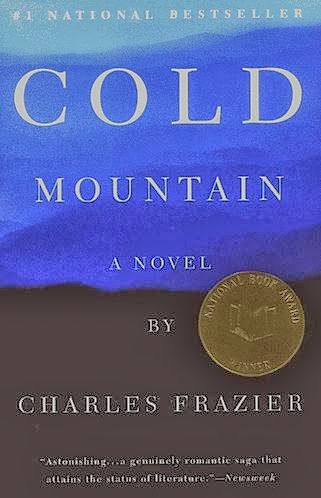
Cold Mountain (3 of 145)

One Sentence Summary: The intrepid Inman journeys across the unforgiving landscape of the Civil War South in hopes of reaching his beloved Ada, a young woman tending the land and changing with the times on the other side of Cold Mountain.

Subtitle: Come to Beautiful North Carolina!

Excerpt:
“He tried to name which of the deadly seven might apply, and when he failed he decided to append an eighth, regret.” 
I have the travel bug big time. Right after high school, I ocean hopped to Spain and then wrangled a position with a company back in the States that ultimately sent me to India. I got back about six months ago (I can't believe it's been that long) and I've been busy, but oh my goodness, I am starting to get jumpy again. Itchy feet is a curse. Mix that with my recent fascination with the American South and reading this book was the final element in a volatile Kerouac-ian cocktail.


Beautiful descriptions make me weak in the knees. Dandelion Wine will forever be my favorite summer book because it is summer, written down and pressed between some pages. I bring up that Bradbury classic as an illustration of the fact that I am not afraid of slow-burn storyline, winding its way through corridors of description. John Muir's wilderness essays? Right up my alley. For fiction, Cold Mountain has some of the most beautiful descriptive language that I have read in a very long time. The juxtaposition of feeling and landscape, each a tool that enhanced the understanding of the other, was absolutely masterful. Throughout Inman's great American odyssey, you can feel the threat of approaching winter, the long slog of the unchanging road, the minute thrills of witnessing evolution in the landscape. Also, by Ada's side, your heart steps into a more primal space- you get to learn to appreciate Cold Mountain, and all mountains, for their quiet language alongside her. It spoke straight to an ongoing monologue in my heart, a yearning for simplicity- love and toil in a beautiful place as a recipe for a well-lived life. Ruby and Ada speak straight to the ongoing war between the urban intellectual and the rural sage that I get to experience in my own life, poised between the middle of nowhere north-country and the influence of Boston and New York. 

There was an enormous purity to the whole arc of the story that I was able to get lost in, because I seek it so constantly in the spaces between books where my own narrative unwinds. Inman's love of Ada. Ada and Ruby's friendship (my favorite element of the book). The landscape itself. Now that I write it, purity is the word for it- a book clear and cold as mountain air.


All of that being said, I sometimes lost the thread of the story. It disappeared under a few interrupting narratives that didn't seem to quite fit in, the way they were written and some of the more beautiful moments lost their weight in descriptions of process that went on for just a couple of paragraphs too long. Still, the experience of the whole book is worth it. Cold Mountain is often referred to as a "contemporary classic". I have to say that I think that fits.


I'll be watching the movie this week and I'll follow up with some thoughts. I've been told not to expect much, but come on guys- Nicole Kidman and Renee Zellwegger? I'm probably going to dig it.

I left my paperback copy, gleaned from God knows where, on a shelf in the '70s throw-back ski house that I stayed in this past weekend, right between the Jan Karon and the Reader's Digest condensed novelizations. I'm not one to judge, but I think it's safe to say that the contribution slightly raised the quality level on that shelf.

Special Note: Pair this book with Goldmund's "All Will Prosper" album. It's all beautiful Civil War tunes set re-arranged with Goldmund's signature atmospheric mood music. So good. It really heightened the experience.

I recommend this for: wanderlust types, Civil War buffs, Bradbury fans
I do NOT recommend this for: people who describe their ideal read as "fast-paced", Ulysses S. Grant