Tuesday, February 17, 2015

Lost in Austen

I know it is verboten to suggest that you may enjoy a movie adaptation more than you enjoy the book itself, but I'm gonna say it. I'm gonna say it. I love the Pride & Prejudice movie, but I have never been able to push my way through the book. I'm hiding behind a stack of Bronte novels until the firestorm dies down out there.

Okay. In my defense, it is not for lack of trying. I have curled up with literature's favorite repressed love story several times. In theory, it should be my favorite kind of book: spunky heroine, spunky authoress, social intrigue, and most importantly, British people riding British tropes like little trope show ponies. And yet... and yet.

For years, I have been able to hold up my end in an Austen conversation through sheer osmosis, even inherited a bit of the Darcy inspired swoon that is so common among young women of a certain age, but have been haunted by the nagging reality. I have never read a Jane Austen novel. As someone who can read a couple of books in a day if she tries, I sometimes feel as if I don't have an excuse to read a book that I don't have interest in if it is canon. There's almost a sense of responsibility to yourself, to better understand common influences. Everyone wants to feel well read and culturally in tune. Sometimes, when something that resonates with so many people doesn't strike a chord in you, it can make you feel a little broken. And so I have nursed the sore of my Austen free reading record for a very long time indeed. With this winter sowing its brain death seeds in every New Englanders' cup of tea by February, I decided that there was no better way to fight the slump of the season than by taking on a reading challenge. And, I reasoned with myself, what could possibly be more challenging than Austen?

I knew I couldn't read Pride and Prejudice. If I failed to complete it yet again, I might never recover and even the over-arching cultural charm of the work might fall short of reviving my interest. I've seen the movie for Sense and Sensibility and love it because Emma Thompson and, just in case I despised the book, I steered clear so as not to ruin a favored film. And so I chose Emma, the only major work that I was completely and utterly unfamiliar with. As a bonus, someone dear in my life often refers to me as "Miss Emma Wodehouse" and I figured I might as well use this challenge as an opportunity to get to the bottom of that comparison (by the way, I can see it now).

It was rough.
I made excuses to avoid it.
I watched an entire season of Criminal Minds.
I decided I was behind on my aimless internet reading and took admirable steps to repair that.
And when I pulled myself over that finish line and everyone and their best friends got married, I looked back on the entire week that it took me to read my first Austen novel and realized

I didn't hate it.

While I may not have converted into a Jane Austen fan by any stretch of the imagination, I am glad that I undertook this because I now completely understand why people adore her works. I realized it was never a matter of quality, but a question of taste. I don't read romance novels. Unless there is a love interest standing in the way of my taut non-romantic conflict, I don't really want to read about it. In high school, I would reach the romance portion of a YA novel and roll my eyes, flipping past all of the quivering, sideways glances, and sighing. I love romantic films and, for whatever reason, that medium resonates with me, but I've never had much of a desire for my literature to be served hot, if you know what I'm saying. That being said, Austen will probably never be what excites me about coming home from a long day of work. But at least I now know why she provides just that for so many people.

Jane Austen totally gets it. I imagine her sitting on the edge of the activity in the parlor and simply watching. She was so very clearly a great student of the strange ways of the human heart in every kind of relationship, daughter-father, woman-man, woman-woman, and every nuanced sort of interaction in between. I felt an enormous intimacy while reading Emma, watching unbiased character sketches play out in just the way as people always do, of any class or creed, petty and generous and dear and conniving in turn, all in the same heart. Austen understood the power of a single word or the pain that can come from an off-handed sort of gesture. She understood what drives us to wound or to interpret our way to being wounded. Reading her dialogue, I simmered a little in my crock-pot of literary elitist jealousy. The dialogue was so alive and believable, that I felt as if it was overheard. Austen had the rare ability to know which words needed to be left out to say the most and writers spend their entire lives without even realizing that that is a lesson they need to learn. But Austen does not need me to defend her or even to go on about what made her so special. With or without my patronage, she has gently walked into so many hearts throughout history and whispered them love and hope and healing. My taste or opinion cannot do the slightest bit to change how darn wonderful that is. All I can do is bow my head to her prevailing charm and gentle wit and scuttle back to my museum of quirky wonders.

"There is no charm equal to tenderness of heart."
~ Jane Austen's "Emma"

So true, Jane. So true.

Friday, February 6, 2015

Reading Goals for 2015

February seems like a funny time to get this post written, but I am actively avoiding reading Emma (sorry, Jane) so it feels like a good time to update.

In this post from September (oh dear, I have not been particularly diligent, have I) I discussed the evolution of my perspective on my own reading life. It has been an exciting and validating process for a life-long "book-worm" to take a "hobby" and begin to view it as a life-style. That being said, I will keep this brief and express a couple of goals I have for myself in 2015 as a reading year.

Stage One
Read more diversely. 2014 was the year that I really became aware of the existing disparities in the publishing community, particularly for authors of color. My own reading experience has been pretty white-washed up to this point and I want to change that. The scope through which I see the world seems small for the amount that I have read, but that can be attended to. I am also trying to expand my reading of the history of people of color as penned by people of color. The victors write the history for the schoolbooks, but the truth is infinitely more complex and it is definitely out there.

Stage Two
The year of Arthur. In 2015, my major reading project will be the original Sir Thomas Malory's Le Morte d'Arthur paired with the complete T.H. White's Once and Future King saga. Growing up, I could not put anything Arthurian down. T.A. Barron's Lost Years of Merlin series and Gerald Morris's The Squire's Tales , paired with so many other stand-alone titles and a brief spat of obsession with the questionably decent musical "Camelot", defined my reading and writing dork self in major ways. Last year, I binge-watched BBC's "Merlin" and I binge-watched it hard. My Morgana Pendragon love is a roaring fire. Anyway, this particular project is the extension of that obsession, but in a more grown-up way. Not to mention, Pendragon Cycle? I'm coming for you.

Stage Three
Reread The Hobbit, The Lord of the Rings, and complete The Silmarillion and Books of Lost Tales. These books are so familiar to me that my tattered copies of the movie editions have soft corners from my greasy child-thumbs. I read and re-read the Battle for Helm's Deep over and over again. An entire wall of my room is a topographical map of Mordor. And, as I'm sure it was for so many people, Tolkien's masterpieces are the reason I started to write fantasy fiction, my dearest literary love. With that in mind, it has been too long since I sat down and disappeared to Middle Earth.

Hundreds of pages of poorly written LOTR fan-fiction in binders with maps hand-drawn in pencil. Fighting over the Legolas bookmark with my best friend.
Jejune summerwinterautumnspring afternoons spent living life as "the last of elf-kind" in the backyard.
Prophecies. Rhyming prophecies everywhere in everything I wrote forever.

I think that's all that need be said.

So those are my three major reading goals for 2015 (with all of the other books to be read in between). As for the reading goal I'm working on at this very moment? Jane Austen. Read a Jane Austen book. Any Jane Austen book. Trust me, I will have a lot to say whenever this book is over. That is, if it is ever over.

Friday, September 26, 2014

Ch-ch-ch-changes!

When I started this project, back in January, I really failed to take into account a few of the realities that would make it difficult. Not least among these is the fact that I cannot stop buying books. The intent of the project was to whittle down my collection of unread books as I prepared to move out of my parent's house. Noble, certainly, but completely ridiculous as I failed to take into account how I had acquired them in the first place- that is, constantly and with glee. Imagine cackling and achy smile muscles because those are the facts. As the book hauls continued, I lost count of how many books were on the list and I continued to accumulate volumes far faster than I read them. Then, there were all of the books I borrowed from other people and... you get the idea. 

Still, I would in no way consider this effort a failure. Over the past several months, through the influence of the books I have forced myself to read (Toni Morrison's "Beloved", Ray Bradbury's short stories, Wilde's "The Picture of Dorian Gray", David Sedaris, and other non-fiction that I may otherwise have shied from) and more seriously seeking out resources such as writers on twitter, the Diversity in Fiction movement, and the amazing Book Riot podcast, I have begun to frame my reading as a "reading life". It has always been that, a separate feeling existence that informs my character and real-world responses, but I had never thought of it that way. There is a lot of power in simply changing the way you name a thing and, consequently, look at the thing. I am now more aware of striking the fine balance between reading things that I simply don't want to read and still managing to read widely and deeply. I feel more responsibility for what I consume and who it is by and how it affects my perspective. But this has not limited me at all. If anything, I am more hungry than I have ever been. The writing itch has returned. There is eagerness and inspiration and I do not forget to look at the night sky so often. One needs to be reminded.

I just finished Francine Prose's Reading Like a Writer. While it wades in ambiguous waters a little too often, the heart of the work still comes across. Read because you are hungry and then use it to feed others. Study art to create art. Study art to create the life you are capable of. Stay hungry and create your own opportunities to come to the table. Be comfortable with knowing little so that you never run the risk of thinking you know anything at all, because that would be truly limiting. 

I am going to continue to maintain this blog, even if no one else reads it, because I want to remember and to share this hour of my life and how what I am reading is keeping the light on. May that light always bring people to a home filled with books. Anyway, I should definitely be working on my TBR list... all 1,199 of them.

Thursday, August 28, 2014

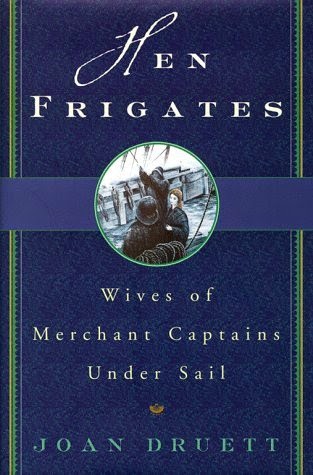
Hen Frigates by Joan Druett

It all started with Moby Dick. My mother recounts the tale of my love affair with Moby Dick with great enthusiasm and frequency. How I brought it home from the library, my first real tome of a book and announced that I was reading it. I was probably eight or nine years old. I remember pulling it off of the shelf, a little intimidated, but mostly stirred by its heft and reputation. Here was a real classic- a grown-up classic. The closest I had come to the much-revered "canon" was my mother reading Little Women out loud to me, a cluster of memories that have bled into one great warmth over time. Moby Dick seemed the right kind of rite of passage for my reading life, a thing I was actively developing at that time, without necessarily being aware of it. Here is my mother's favorite part of the story, though. I disappeared upstairs with my library haul. There was silence for a time and then the sound of someone goose-stepping down the stairs. I walked past her, collected a dictionary, and then took myself back upstairs. For the next two weeks, she would find me laid out on any variety of surfaces around the house with the spine on Moby Dick cracked and the enormous family dictionary laid out beside. And that's the story of how I read my first big-kid classic, Moby Dick

This was going somewhere. Oh right, Hen Frigates. The great white whale was the beginning of a life-long fascination with all things maritime - pirates, sea critters, all things that sail, swim, and lap against the shore-line. Joan Druett's book on women who went to sea with their husbands in a time when they didn't even have rights on land is impeccably researched, well put together, respectful, and earnest. She uses an enormous amount of narrative pulled directly from the diaries, letters, and musings of the "hens" themselves and speculates only within the parameters provided by those first-hand accounts. I was so struck by the lives of these everyday women, bearing up or tumbling down in the most unpredictable of environments, in the best or worst of times, and I got to hear it in their own voices. Rough or refined, nagging or gentle, all so unique, with such varied bags of troubles. They are so human and wonderful and this book made me fall in love with history again for the reasons that originally brought me to it- common people. Ordinary people living out the lives given to them, loving and suffering and finding joy in the strange occurrences of lives that burn brightly in their own quarters and then go out. Ms Druett has ensured that for this fine and unlikely breed, the wives of merchant captains, there will always be a candle burning. I'll read anything this woman writes.

Shelf Status: Keeping to loan out to other history dorks
If You Liked Hen Frigates, You May Like: In the Heart of the Sea

Tuesday, July 22, 2014

The Night Circus by Erin Morgenstern

One Sentence Summary: Marco and Celia are the pawns of their masters, weaving a circus of dark beauty each night for the gratification of an ominous challenge, but when they fall in love, the veil will be torn asunder and they must be more clever than fate and stronger than death to bear what is to come.

Excerpt: "The circus arrives without warning. No announcements precede it. It is simply there, when yesterday it was not."

I was primed for this book. The thought of a dark circus- the tantalizing possibility of such a setting and tone, has lingered long at the back of my mind, planted by Ray Bradbury's Something Wicked This Way Comes. I attempted to read that book every year at Halloween time for several years before I was able to creepy-crawl myself past the sequence when the boys are in the tree and watching the demented nude dancing of the troupe through the windows. Don't remember the part? Well, I do, because it was what sent me skittering under the covers every October for at least three Octobers. When I was old enough for the creepy mood of that book to be more enjoyable than torture, it became a precious doorway to me- to Bradbury, to beautifully constructed horror, and to the tenuous space where dreams and nightmares meet through story. 

The Night Circus is not horror. It is not constructed to be disturbing or even particularly off-putting, but unfolds as one may open a mysterious invitation, tempting you into complete immersion. You open the book and are walking through the tantalizing iron gate- it is a book that gives you a feeling of having been selected, uniquely privileged to see what lies within, behind, and then beyond. Morgenstern's imagery is compelling and unique. She writes with the desperate momentum of someone who has carried a story inside them for too long.  It unfolds, each page with wonders more beautiful and fully realized than the last. I found myself thoroughly hypnotized by the world she had created, joyful in its excesses, and blind to its holes. In that way, The Night Circus once again returned me to Bradbury- a descriptive writer's write, a playground for dreamers.

There were some holes, of course. This is not the perfect book. The protagonists sometimes feel thinly plotted, ghostly even, beside the supporting cast. I could not wrest Thiessen, Bailey, or the alluring contortionist from my mind- the man in gray, layers as numerous as the elements of his suit, demanded his audience, but Celia and Marco sometimes felt insubstantial, flimsy vehicles for the focus of this story- the Night Circus itself. I can see how, if you were not a reader who was swayed by setting as character, this book would leave something to be desired. The plot is similar- its nuances are sweeter than the grand scheme. I would have liked a more aggressively detailed magic system, if we are going to get specific. Perhaps it was part of the mystery that the science of the unknown stood on feeble legs indeed, and this may be a matter of preference, but I like my magic served well done.

Ultimately, one gets the feeling that what this circus is to the reveurs, it's caravan following in the story, the book is to its author- wish fulfillment. Luckily, I felt that she succeeded enormously, because that is exactly what it is for the reader as well. Several weeks later, I cannot shake the sensation of this book- caramel corn. Light, quickly consumed, and best when shared.

Shelf Status: Keeping to share heavily
If You Liked The Night Circus, you may like: Something Wicked This Way Comes, Airborn, The Ocean at the End of the Lane

Friday, June 27, 2014

The Food of a Younger Land by Mark Kurlansky (21 of 171)

One Sentence Summary: Food writer Mark Kurlansky stumbled upon the lost files of the Federal Writer's Program of the Great Depression- files where they discussed the food at the center of households and communities, ways of eating before the highway system and food preservation modified our regional food habits forever. This book is a collection of those essays.
Food is our common ground, a universal experience.
-James Beard
I love books about food. My entire life, my mother was a brilliant cook who catered (pun intended) to the varied whims of the family table without ever sacrificing quality or, for that matter, quantity. Throughout my childhood, she would try valiantly to get me to take any interest whatsoever in even the most minute of the sacred rites that defined the kitchen: pinching oregano into a sauce, cracking black pepper, or grating parmesan. I resented all of these tasks and set them on the same level as washing dishes or putting things in the recycling, things that carried the suspicious feel of chores. About a year ago, I suddenly became interested in cooking- perhaps it is an interest that comes with maturity, although it is more likely a skill that grows alongside necessity. I was suddenly attracted to the making aspect of it. I've never been able to make much of anything. Doing things with my hands gives me a special type of anxiety, the same that I experience with dancing. But cooking? This I could grasp. There is a fluidity to it, a deeply creative aspect that appeals to me, but aside from all of that I am attracted to this deep sense of community.

Mark Kurlansky is the sort of non-fiction writer that you would imagine would be excellent company at a dinner party- full of information and enthusiasm about it. Still, even his excitement over these tid-bits from the past could not save some of the writing from a lack of editing and consistency. The format made it a little difficult to read- one second you were enjoying someone's lush prose over Creole gatherings, in the next you were subjected to halting and awkward descriptions of barbecue, all crushed up next to each other. It was a book that required some weeding to enjoy. Still, I understand the editor's intent. Kurlansky was hoping to give each author their moment, to make Younger Land as close to what it was originally intended to be as possible. If you're a foodie, or a history dork, there was much to gain despite poor passages. This book is a treasure trove of funky recipes and a great reminder of the importance of community, but is also a great instigator of thought. Is it good that we eat the way that we do? Is variety really the spice of life- or is instead better to coax the food in every way, from seed to mouth? What have we gained and, because of it, what have we lost? Delicious questions.

Shelf Status: Passing along to Erin of the canning blog, Putting Up with Erin. That seems like the right home for it, for now.
If you liked The Food of a Younger Land, you may like: Eating Animals, The Omnivore's Dilemma

Thursday, June 5, 2014

I Have a Problem: Volume VII


"What Lips My Lips Have Kissed and Where and Why" is one of the first poems that I read over and over again. St. Vincent Millay led a fierce and complex life and she really shook things up for her time. But for a woman who could look into a camera and seduce you across the ages, her vulnerabilities and strength come across in equal measure in her poetry. She reminds you that people are often infinitely more complex than the bare expression of their actions. 


My boyfriend's brother recommended this and I hear there's a cat in it. That's only partly a joke. This book has something of a cult following and everyone that I've spoken to who has read it absolutely loves it.


I read The Innocents Abroad when I was in India and fell in love with Mark Twain in a way that I never had when reading Huck Finn in high school. Twain pulls no punches and, as someone who has grown up in the age of the politically correct, it is refreshing to read someone who is not apologizing every other sentence.


This book is my latest addition to my collection of good ol' fashioned ghost stories. I have a fascination with Nantucket, because whales.


I love books about places and also things that go. This means that I am attracted to board books designed for children who cannot yet read and books like this.

167, 168, 169, 170, 171

Friday, May 23, 2014

The Moonstone by Wilkie Collins (20 of 166)

One Sentence Summary: The Moonstone, a mysterious gem of India, supposed cursed, brings mayhem, theft, and death to the lives of those who possess it.

Excerpt
“We had our breakfasts--whatever happens in a house, robbery or murder, it doesn't matter, you must have your breakfast.”
This is the first Wilkie Collins book that I have read and as I was able to get through it and have never been able to get through a Dickens tome (with the exception of A Christmas Carol, which is decidedly un-tome-like) , it looks as if Collins has already pulled ahead in my affections for authors of their time. Collins seems underappreciated to me and I have to wonder if it is because he was operating in the shadow of his friend and contemporary, Dickens. Granted, my impressions of him have been swayed by a reading of Dan Simmons' fictional Drood. What is true from that thoroughly unimpressive book is Collins' opium dependence, which comes across in an alarmingly close and telling manner in The Moonstone. At one point, a character with a dark history and an issue with the nefarious drug, gives an extensive account of the effects. They are so intimate and accurate, you can't help but feel a little uncomfortable, considering the author's history.

The Moonstone is a classic detective story- a whodunnit of the old tradition. Agatha Christie probably cut her reading teeth on it. Daphne DuMaurier must have curled up in a bay window, rain pelting against the outside, and devoured this tale of robbery, blackmail, and mayhem. The mark of a great mystery, in my mind, is when it pushes the reader to feverishly try and solve it before the characters get around to the task. I had a running list of ten possibilities, each shifting up or down the list and morphing as the pages turned. There were at least two shock-worthy moments where the story took completely unexpected turns. I can't imagine how this must have driven readers mad when this was first published in serialized form. So many miniature cliff-hangers! How did they bear the wait between editions? 

Collins's use of unreliable first-person narrators throughout kept you guessing what was truth, what impression, and what was outright untruth. While I have great praise for nearly all of them, I am especially obsessed with Miss Clack. She was absolutely hilarious. Why is she forgotten when we list the great comic moments of canonized literature? I was sad when her part of the narrative ended, but its briefness gave a great roundness to an otherwise very straightforward plot.

On the negative side, but keeping in mind the time when it was written, there is the classic Oriental fetish of the Victorians at play here. I mean, a cursed Indian stone- undercover Brahmin traveling jugglers- mystical Hindu ceremonies? Yeah, okay. I get it. The colonies are the heart of darkness. The Temple of Doom is now. But still, that was the stuff of romps in the day. It is telling and intriguing to look at the culture through the prism of its popular media. 

I am going to be passing this along to my mother and grandmother, fans of Jane Eyre and crime stories, respectively. Bordering on gothic and thoroughly intriguing and delightful with its touch of the tragic and mystical, it's a great read. If you can't get through Dickens, maybe you should hang out with one of his best friends. If the popularity isn't there, the technique and imagination certainly meet, if not surpass those of the famous champion of the poor.

Shelf Status: Passing along
If you liked The Moonstone, you may like: Rebecca, Dr Jekyll and Mr Hyde, The Turning of the Screw

Sunday, May 18, 2014

The Secret of Scent by Luca Turin (19 of 166)

One Sentence Summary: A persuasive argument for biochemist Luca Turin's theories regarding the mysterious scent molecule.

Excerpt:
"The voice of Nombre Noir was that of a child older than its years, at once fresh, husky, modulated and faintly capricious. There was a knowing naivety about it which made me think of Colette's writing style in her Claudine books. It brought to mind a purple ink to write love letters with, and that wonderful French word farouche, which can mean either shy or fierce or a bit of both. I immediately bought a very expensive half-ounce in a little square black bottle." 
I am thoroughly intimidated by anything more than cursory approaches to the sciences. For the most part a decent student in high school, I hung on by the skin of teeth in science classes year after depressing year. It is not that I do not appreciate science; don't get me wrong. I actually love it. I experience the same strange pull to it that I do to all fields with any mystery left to them. It is just that curriculum everywhere manage to squeeze all of the goodness out of a thing and replace it with the knee-knocking fear of senseless equation running. Equations are beautiful things, but not when they have stripped down to their use on standardized testing. You catch my drift. I think that it must be nearly impossible to separate a love of this world from a love of science. High school achieved it. Remarkable.

Something that I do have a decent understanding of is perfume. It may a seem a superfluous sort of interest, a bourgeoisie fascination, but I would argue that belief to come from a root of ignorance. Scent is integral to our relationships, to each other, to ourselves, and to our environment. It is the sense most strongly linked with memory and association. And yet, when it comes to finding the sensory calling card that you will leave most subtly and inexorably on those you meet, we deem the pursuit vanity. Why am I into perfume? Because it is complicated and romantic and different for every person out there, because it is full of beautiful language both technical (fougere, aldehydic, chypre) and descriptive (blousy, biting, sensual, woody), and because the legacy of scent is so strong.

Taking into consideration the above two paragraphs, one begins to understand how I managed to finish a book that, by its very nature, gave me test-taking anxiety. Luca Turin writes on his topic with so much passion and excitement that you cannot help but feel that scent molecules are the most important thing to happen to science since the microscope. Even as I labored through pages of complicated (for me) formulas, it always became worth it for me upon reaching another milestone where the shop talk turned back to perfume. Turin managed to make his book about more than his theory (which is fascinating, by the way)- he managed to make it a scientist's love letter to an arcane and under-appreciated art form. Better than that, he wrote with all of the sass of a self-assured Frenchman. Like a complete bad ass, he shrugs off his nay-sayers by casually reminding that he has used his theory of scent to generate synthetic molecules for Flexitrol for several years now. Excuse me, but:


I only wish I had a better grasp on the technical aspect of this little treatise on scent.

I would like to take a Chemistry 101 class and then return to this text to see what else I can take away from it. But Luca Turin sounds like someone I want to take up over the perfume counter in some back-alley Parisian boutique and talk Coty, Chanel, and everything in between, up, down, and diagonal. 

Shelf Status: Keeping for now. Perfume books are few and far between.

Tuesday, April 29, 2014

The Color Purple by Alice Walker (18 of 166)

One Sentence Summary: Celie, an impoverished black woman living an agonizing cycle of abuse and oppression, comes to find her inner light enabled and bolstered through the course of her life by the people and events that come through it.

Excerpt
“I think it pisses God off if you walk by the color purple in a field somewhere and don't notice it. People think pleasing God is all God cares about. But any fool living in the world can see it always trying to please us back.” 
I actually can't believe it took me this long to read this book. It's another major school reading list champion and I guess I always avoided those- I was going to be forced to read them eventually, so why go out of my way? That was probably the thinking. Foolish, of course. Most of the books on those reading lists are on there for a reason.

From a writing perspective, Alice Walker is unreal. Her ability to write dialect and ignorance and perspective is so inspiring, it makes me want to write my butt off. I love how, with this particular craft, simply reading is perhaps the best way to learn from the masters. I feel as if my life is overflowing with the power of the two incredible women I have only just now been exposed to- Toni Morrison and Ms. Walker. They are separate entities, with strong individual identities, but their joy for life is so completely unbridled and seeping through the cracks of their work, that I will think of them together always. I cannot relate to many things in their books, particularly the American black experience, not directly, anyway, but I am learning learning learning. Even struggling to comprehend that element, I feel as if I am leaning on their formidable shoulders. 

When it comes The Color Purple specifically, I am just in awe of Celie. The characters are so believable and vivid- but all come to being beneath Celie's forgiving and increasingly wise gaze. Growing with her is a privilege. You find yourself wanting to weep tears of joy as she comes into her own and grasps life and takes a hold of her future and discovers the unquenchable thirst of her spirit. At first I thought that I was meant to love Shug for bringing the wrecking ball into Celie's constructs of self-defense mechanisms, but then I realized it was Celie gently teaching everyone, even as she learned. There is so much pain in this book; the first few chapters are even a little exhausting in the scope of their abuse and hardship, but it sets the stage for a story about hope that must be among the greatest ever written.

 Life is hard, chickens, but the light is just a few steps further, always.  You can take that away, no matter what your race or history, because everyone has felt pain, been betrayed, and stood alone in the darkness sometime. Their tales remind me of how our lives do not run parallel to those of others- how instead, we wind and weave through the narratives of friends, families, and enemies alike. In that way, the tapestry becomes strong- wind and weave, wind and weave.

Shelf Status: Moving Along and someday buying a copy with the binding attached
If You Liked The Color Purple you may like: Beloved , The Invisible Man, All Over but the Shoutin', The Immortal Life of Henrietta Lacks

Monday, April 21, 2014

Snow Falling on Cedars by David Guterson (17 of 166)

One Sentence Summary: The suspicious death of a local fisherman becomes a murder trial informed by the prejudices and agendas of residents of a post-war island community off the coast of Puget Sound. 

Excerpt

“To deny that there was this dark side of life would be like pretending that the cold of winter was somehow only a temporary illusion, a way station on the way to the higher "reality" of long, warm, pleasant summers. But summer, it turned out, was no more real than the snow that melted in wintertime.”
My love and I went to see a reading of David Mamet's play Race not too long ago and were blown away by the narratives of inherent racism and prejudice. We sat in the dark as the actors sparred for the salvation of our culture's very soul, it seemed. It frankly addressed the things that we skirt around when the conversation of prejudice comes up in real life: "I know it's a problem, but not mine." , guilt and shame, and the necessity of acknowledging that being a non-racist, for lack of a better word, is learned behavior- a painstaking process of unlearning. 

I was brought back there when reading Snow Falling on Cedars. As a reader, it is clear enough to see where old prejudices and anxieties come into play, even when the characters do not. The white population of the island comes across as long-suffering. They resent the presence of their Japanese neighbors even now, fifteen years after the conclusion of the war. For some, it is the echoes of their assailants from the Pacific theater, for some it is the deeply rooted sense of prevailing "otherness" that pervades their perspective on other races, and for some it is guilt- that they stood aside and did nothing as people they knew to be good and honest were torn from their homes and transported to internment camps. As the court case unfolds, it becomes increasingly clear that what the Japanese defendant projects as dignity, is perceived as defiance and with every psychological stroke against Kabuo and his family, your heart breaks with the injustice of it. Sadly, there may be more modernity to the commentary than one wishes to believe.


I was not loving Snow Falling on Cedars when I started it. I read Guterson's A Country Ahead of Us, A Country Behind last year and didn't really love it. There were a couple of stand-out moments in the short story anthology, but overall, it missed the mark for me. His moments of sparsity came across as pushing through to a part he would rather be writing, sometimes those moments were he chose to dwell on description, went on a couple of beats too long. Where there was balance, it was beautiful- but you shouldn't have to seek those moments out as a reader. I'm always wary of books with intersecting storylines where I favor one arc to the exclusion of the others. We've all been there, flipping ahead to see where the chapter ends so that we can sink back into the part of the story that matters, dammit. Snow Falling on Cedars fell into that trap, with one additional faux pas- the details meant to lend it a sense of the crime-novel procedural, instead served to bog it down. Usually those details are there to heighten your awareness. Any little piece could matter! Not so with this book- if something is going to matter, Guterson will let you know, so you can let your guard slip for all of those finnicky stacking paragraphs of info-dump.


Still, it's not fair to judge Snow Falling on Cedars as a glowing example of a mystery- I don't believe it's really written to be one. The crimes in this book run deeper than the murder of Carl Heine. The tragic incident is merely a backdrop for Guterson's more sweeping statements regarding the lingering mental state of the island-folk. He does a beautiful job bringing out the humanity of the majority of the characters and utilizes tropes to enhance his story, without letting his awareness slip and surrendering to the siren call of writing stereotypes for their simplicity, not their irony.  His real skill lies in developing characters as ultimately unknowable as real human kind and in bringing you to island of San Piedro. It unfolds, a deeply beautiful and treacherous landscape of sea, rock, lofty cedars, and tumbling strawberry fields, with a personality and a purpose. By the end of the book, you've walked the pathways and streets into familiarity. Guterson's passion for the locale is so clear and convincing that you cannot help but feel the melancholy of missing homeland during reading. For a moment in time, you belong to San Piedro and it is all too far away.  I understand why this book is considered a contemporary classic- why it's on so many high-school reading lists. The message is clear and unwavering, the themes are timeless. Where Guterson's momentum failed him, his conviction kept the story alive. It is certainly worth reading, if only to feel that you have traveled and seen a person for who they really are. After all, how often can we know a person's heart so intimately outside of the realm of literature?


Shelf Status: Moving Along

If You Liked Snow Falling on Cedars, you may enjoy: Cold Mountain, Amsterdam, Mystic River

Monday, April 14, 2014

Beloved by Toni Morrison (16 of 166)

One Sentence Summary: The dark presence that pursues an ex-slave woman and her family creates a maelstrom of heartache and memory in its vengeful wake.

Excerpt:
“There is a loneliness that can be rocked. Arms crossed, knees drawn up, holding, holding on, this motion, unlike a ship's, smooths and contains the rocker. It's an inside kind--wrapped tight like skin. Then there is the loneliness that roams. No rocking can hold it down. It is alive. On its own. A dry and spreading thing that makes the sound of one's own feet going seem to come from a far-off place.” 
This is a long overdue read. I paid it little mind when it appeared on reading lists in high school as an option- I was far more concerned with reading fat classics with intimidating reputations than this slender volume and its unapproachable subject. A copy found its way into my hands, and that copy into a dark corner of my closet, and there it sat and waited and waited, as so many books have done all of these years. Well, today I finally sat down with it and I read... and read... and read. I read for hours. My heart is sore. My eyes are tired. I feel a little shaky and out of sorts, because I have spent so much time, a small lifetime, on this couch, having this book move through my insides and take up roost in my heart and soul. I could not turn away from the agony and memory of these characters, now so much a part of my life, and the real world seems foggy in that special unreality that comes only from surfacing from the deep waters of a text with no bottom.

Toni Morrison writes about heartache and evil and simple goodness and pain and jealousy and need and want in ways that I have never encountered. She speaks straight to the heart of all that is fragile and secret in the heart of a person, but particularly of a woman. The reader feels keenly the shame of Sethe's life, of living in a world that can do such things, strike such fear of living, into a human being. The story comes out, a long red thread, ducking and weaving through the non-linear telling, and it is a dark flower blooming slowly. Morrison's work is switchblade poetry, deceptively beautiful and raw. Lulled by the language, you are all of a sudden locked in the simmering microcosm of 124 with its unfortunate denizens- flawed, desperate Denver, regal and shattered Sethe, blessed Paul D, Baby Suggs, holy, and Beloved- the gentle to heavy pressure of Beloved, always, haunting the house. Once again, I am reminded that the great ghost of the sins of this world bears the face of a child. 

Learning about slavery in school, there is and always will be a certain amount of separation. A detailing of the atrocities may make you pause for a day, but this book is the photograph that takes up residence behind your eyes. I once saw a black and white picture of a box of wedding rings removed from the hands of Holocaust victims. That box was so deep and wide and full and it is part of the catalog of my finite experience that informs my world view. Here we see straight into the aftershocks of humans treated as animals, denied themselves, and it is so painful and so necessary because this work of fiction, like most, walks the well-beaten paths of reality. Beloved demonstrates the power of literature simply by being- this is what a book can be: a sword and a trigger.

I will never forget these characters and what they represent. Beloved comes into your house and unless you will yourself to forget her, she never really leaves.

Shelf Status: Keeping
You May Enjoy Beloved if you enjoy: The Invisible Man, East of Eden, Night

The White Tiger by Aravind Adiga (15 of 166)

One Sentence Summary: Balram Halwai, hailing from one of many (any) villages in the great swath of neglected rural India, becomes the first driver to the son of a coal magnate and, desperate for real opportunity, murders him.

Excerpt:
“Go to Old Delhi,and look at the way they keep chickens there in the market. Hundred of pale hens and brightly colored roosters, stuffed tightly into wire-mesh cages. They see the organs of their brothers lying around them.They know they are next, yet they cannot rebel. They do not try to get out of the coop. The very same thing is done with humans in this country.” 
I spent six months in India last year and am still processing the experience. The White Tiger is disturbing, but even more disturbing when you know how frank and completely possible it is. Spending time in the head of Balram Halwai, you could be in the head of any number of individuals whose lives are placed in the careful boxes of caste and class. The more you think about it, the less solid any ground becomes. While this book is most definitely a tale that seeks to pull back the veil from modern India specifically, it also makes simple, human observations that extend to the infrastructure of any nation where class designation makes us see each other as less or "more than".  Being in Balram's head made me a bit queasy because, while he is certainly corrupt and ultimately wicked, you can see how he became that way and it is very hard to blame him completely. You sympathize with him and you don't want to, but you must.

Adiga's narrative is sharp and quick and I would have been disappointed had it not been, as it did bring home the Man Booker Prize in 2008. Because of this fluid and accessible writing style, the whole book gives off the feeling of a car crash that you are watching take place, complete with the little building scream at the back of your head. The author's choice to let us in on Halwai's trespass right at the beginning of the story sets up the entire story for a feeling of momentum so intense that you almost want to jump and roll off the train. He pulls no punches in confronting the reader with a harsh underworld that is chaotic and of a darkness that feels well-like, but seems to avoid blatant exaggeration. That being said, I read one review that said that The White Tiger was not a work of literature, but a collection of facts. That puts words to what I was trying to articulate throughout reading. While I do not completely agree with the claim that it is not literature, I also sometimes spotted the profusion of information, it betrayed itself by becoming significant to the point of being noticeable- still, I think it a small price to pay for the level of immersion that Adiga creates. You get all the way to say, the seventh circle of Delhi. Certainly, sometimes this book can come across a bit of a crash course- but I stick to my guns when I say that it ultimately avoids the dreaded feeling of "information dump".

This is one that I would like to abstain from "rating", per se. How would I go about rating it? Did I enjoy it. No, not really. I was glad to finish it, but also glad for having read it. Did I think it was significant and important and worth reading? Oh yes, definitely. On a more personal level, I may never completely understand the unrest that still comes upon my soul when I think of India, but reading brings me closer and I think that this book tapped into that need for me. Still, it is heavy and if you are seeking a happy-go-lucky guru road trip tale, this is not going to be it.

I am now off to go read more heavy literature because I said so in my last post. I think that after Beloved, The Color Purple, and Snow Falling on Cedars, I will be ready for Harry Potter and the Order of the Phoenix- really, really ready.

Thanks, Hannah South, for the recommendation!

Shelf Status: Off to a book tarp in Connaught Place
You May Enjoy The White Tiger if you enjoy: The Invisible Man (Ellison, not Wells), Interpreter of Maladies

Thursday, April 10, 2014

In Which I Take a Buzzfeed Quiz and Hit the Library Book Sale

I took a Buzzfeed Quiz and I'm not ashamed because it was on one of my favorite subjects: banned books! You should take it, too, and then we can compare geeky notes.

http://www.buzzfeed.com/ariannarebolini/how-scandalous-is-your-reading-history

I've read 47 of 93 of the banned books on their list, which means two things:

1. I have a moderately scandalous bookish history- more easily compared to the track record of Zelda Fitzgerald than that of Tallulah Bankhead.


"Scott does worry so over
 my troublesome spells..."
If I smoked one cigarette for each of the scandals of the day,
Hollywood would have a cigarette shortage.

 2. I have to step up my game!

There were several books on the list that I have been intending to read and three of them were even on my list for The Great Book Liberation Project (explained at the end of the link rainbow)!
1. Beloved by Toni Morrison
2. The Color Purple by Alice Walker
3. Snow Falling on Cedars by David Guterson
I am going to pick up a cheapo copy of 1984 tomorrow so that I can add it to my project. It may shock you, as it certainly shocks me, that I haven't read it- but when I first tried there was sex and I got a little fit of the vapors because that was my knee jerk reaction to any mention of sex for a very long time while growing up. So let's say,
4. 1984 by George Orwell
Those four books will be my next four reads in the project, methinks. I am currently reading White Tiger.

I also purchased four books at the library book sale and one book while I was out tonight. Please don't look at me.


This project is never going to end, is it?


In other news, I heard peepers as I drove home this evening and finished my route with an absurd grin on my face. Spring is officially here and not going anywhere. 
If you don't have peepers in your life, I am so sorry. Here is an explanation of what they are.
Here are 10 continuous hours of what you're missing out on.

Captains Courageous by Rudyard Kipling (14 of 159)

Book covers of this type always make me wonder
 if they were painting from wooden models
One-Sentence Summary: The insufferably spoiled Harvey Cheyne topples off of his cruise-liner and into the lives of his rough fishermen saviors, only to be transformed by the manly virtue of their craft.

Excerpt:
“It was the forty-fathom slumber that clears the soul and eye and heart, and sends you to breakfast ravening. They emptied a big tin dish of juicy fragments of fish- the blood-ends the cook had collected overnight. They cleaned up the plates and pans of the elder mess, who were out fishing, sliced pork for the midday meal, swabbed down the foc'sle, filled the lamps, drew coal and water for the cook, an investigated the fore-hold, where the boat's stores were stacked. It was another perfect day - soft, mild and clear; and Harvey breathed to the very bottom of his lungs.” 

Teddy Roosevelt was probably all over this book. It was definitely designed to be read by people like this:
Ten bucks says that backdrop is painted.
Not that this was an uncommon audience. Kipling wrote in a time when men were men and boys beat each other up over damaging repressed emotions and daddy issues (but valiantly). I'm not saying there is anything wrong with the turn of the century's boy adventure story genre. One has to be sensitive to the times in which they were written- but Captains Courageous is a whole 'nother story. Robert Louis Stevenson was a contemporary of Kipling's, and while I would have loved to put them in one room to have it out over the treatment of island natives, let's focus on a comparison of their literary work. Where I find that Treasure Island reads as a pure adventure story, Captains Courageous can come across as a bit heavy-handed. Harvey begins the story by being characterized as effeminate and spoiled, a spiney little mother's boy who generally drives others mad with his demanding behavior. He ends it as the ideal son- quiet, composed, just in ways both economical and moral, and smelling ripely of cod. It's a little too clear cut of a moral taleI was glad to say that Harvey was not impervious to weakness- Kipling may have seen Harvey going the way of the flawless convert and so throws in a fainting spell for good measure. Good work, Rudyard. Crisis averted. More than anything, this is just a reminder to take moral character tales of the time with a grain of salt. Or, you know, a whole ocean of it.

I don't want you to think that I didn't enjoy Captains Courageous. I am a huge geek for good naval yarns and history. I like to stand waste-deep in boat jargon and sit down to cramped dinners with swarthy mixed bags of callused crew. As a matter of a fact, reading this instilled in me the strong desire to re-read Moby Dick and In the Heart of the Sea, simultaneously. Good thing Melville's White Jacket is on my shelf, just waiting for its turn in The Great Book Liberation Project. I'm an ocean girl and I always have been. There may be a bit of the selkie in me yet. Kipling captured my favorite elements of the sea story with passion and precision- the fresh air, the colors of the Atlantic, the sense of unbridled curiosity for a secretive and ancient force. I actually stayed up until 12:30, totally immersed in the very satisfying conclusion of the little story. I don't know if Captain's Courageous is as deep as its main subject, but it is still fun and full of little jewels of description and character. 

Shelf Status: Being released to the great and bounding main
You May Enjoy Captains Courageous If You Enjoyed: Moby Dick, Treasure Island, In the Heart of the Sea

Friday, April 4, 2014

The Golden Apples of the Sun by Ray Bradbury (13 of 159)

One Sentence Summary: A collection of Ray Bradbury's short stories spanning topics as curious and varied as time travel, life on Mars, and the summer lives of growing boys.

Excerpt:
'Mr. Douglas,' says the night watchman, 'did you ever read that story about the man who traveled to the future and found everyone there insane? Everyone. But since they were all insane they didn't know they were insane. They  all acted alike and so they thought themselves normal. And since our hero was the only sane one among them, he was abnormal; therefore, he was the insane one. To them, at least. Yes, Mr. Douglas, insanity is relative. It depends on who has who locked in what cage.'
-from The Meadow
I know that Ray Bradbury is considered classic, but even so I think that's not enough praise. In my opinion, he attains that level of storyteller that taps into one of the most important fields of potential for the craft- prophecy. Bradbury's ability to observe human behavior and see where it could possibly lead is almost unnerving. The Murderer is all well and good as a warning against over-socialization and the dangers of social media and constant interaction and bears startling similarities to the modern age, but when you consider that it was written in 1953, it gains a new dimension. Huxley, Orwell, and Bradbury- damn, but they knew what was up before we (my generation) were even born.

I started reading Bradbury with Something Wicked This Way Comes. For years, I would try and fail to read that book because its tone really did something to my head. It was frightening and unsettling in a way that no other book I had ever read was and every October I would take it out from the library and try again. I could not put a finger on why it struck a chord with me where other spooky tales failed, but now I understand it was Bradbury's mastery of atmosphere. When I was finally mature enough to absorb and process it, it became (and remains) one of my favorite books.

Bradbury's descriptions fill in the blank spaces in the world- his imagery taps into a minute internal seed where instinct and truth meet. The way he describes a summer's day or sculpts an entire short story around the complex and deeply stored emotion of loneliness is incredible. It may sound strange, but something within the reader responds to something in the writing. I cannot help but think that the monster in The Foghorn is perhaps the most accurate metaphor for how it feels- an old sort of thinking pulls itself up from your very core and cries, cries, back at the resounding promises in this work. Bradbury reconnects me with my sense of wonder, my desire to set out into the universe and uncover its secrets, and that is why I simply can't stop reading him. His stories are almost infallibly exciting and I always feel exhilarated when I come away from them.  His words on writing and reading remain a constant guide and are perhaps the most accurate words for describing how I feel about my life in words:

“You must write every single day of your life... You must lurk in libraries and climb the stacks like ladders to sniff books like perfumes and wear books like hats upon your crazy heads... may you be in love every day for the next 20,000 days. And out of that love, remake a world.”

Again, I almost always encourage reading anthologies as a full unit, but the pieces that most got to me from The Golden Apples of the Sun were:

The Fog Horn
The Murderer
The Meadow
R is for Rocket
The Great Fire
A Sound of Thunder
The Long Rain
The Dragon

Hmmm, I meant for that to be a shorter list. I guess I couldn't help myself.


Shelf Status: Keeping Forever
I Recommend For: Sci-Fi Buffs, folks feeling out of touch with joy and wonder, writers
I Do Not Recommend For: People who don't do lengthy description