Thursday, October 2, 2014

Friday, September 26, 2014
Ch-ch-ch-changes!
When I started this project, back in January, I really failed to take into account a few of the realities that would make it difficult. Not least among these is the fact that I cannot stop buying books. The intent of the project was to whittle down my collection of unread books as I prepared to move out of my parent's house. Noble, certainly, but completely ridiculous as I failed to take into account how I had acquired them in the first place- that is, constantly and with glee. Imagine cackling and achy smile muscles because those are the facts. As the book hauls continued, I lost count of how many books were on the list and I continued to accumulate volumes far faster than I read them. Then, there were all of the books I borrowed from other people and... you get the idea.
Still, I would in no way consider this effort a failure. Over the past several months, through the influence of the books I have forced myself to read (Toni Morrison's "Beloved", Ray Bradbury's short stories, Wilde's "The Picture of Dorian Gray", David Sedaris, and other non-fiction that I may otherwise have shied from) and more seriously seeking out resources such as writers on twitter, the Diversity in Fiction movement, and the amazing Book Riot podcast, I have begun to frame my reading as a "reading life". It has always been that, a separate feeling existence that informs my character and real-world responses, but I had never thought of it that way. There is a lot of power in simply changing the way you name a thing and, consequently, look at the thing. I am now more aware of striking the fine balance between reading things that I simply don't want to read and still managing to read widely and deeply. I feel more responsibility for what I consume and who it is by and how it affects my perspective. But this has not limited me at all. If anything, I am more hungry than I have ever been. The writing itch has returned. There is eagerness and inspiration and I do not forget to look at the night sky so often. One needs to be reminded.
I just finished Francine Prose's Reading Like a Writer. While it wades in ambiguous waters a little too often, the heart of the work still comes across. Read because you are hungry and then use it to feed others. Study art to create art. Study art to create the life you are capable of. Stay hungry and create your own opportunities to come to the table. Be comfortable with knowing little so that you never run the risk of thinking you know anything at all, because that would be truly limiting.
I am going to continue to maintain this blog, even if no one else reads it, because I want to remember and to share this hour of my life and how what I am reading is keeping the light on. May that light always bring people to a home filled with books. Anyway, I should definitely be working on my TBR list... all 1,199 of them.
Thursday, August 28, 2014
Hen Frigates by Joan Druett
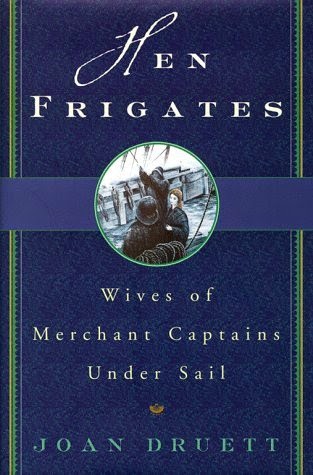
This was going somewhere. Oh right, Hen Frigates. The great white whale was the beginning of a life-long fascination with all things maritime - pirates, sea critters, all things that sail, swim, and lap against the shore-line. Joan Druett's book on women who went to sea with their husbands in a time when they didn't even have rights on land is impeccably researched, well put together, respectful, and earnest. She uses an enormous amount of narrative pulled directly from the diaries, letters, and musings of the "hens" themselves and speculates only within the parameters provided by those first-hand accounts. I was so struck by the lives of these everyday women, bearing up or tumbling down in the most unpredictable of environments, in the best or worst of times, and I got to hear it in their own voices. Rough or refined, nagging or gentle, all so unique, with such varied bags of troubles. They are so human and wonderful and this book made me fall in love with history again for the reasons that originally brought me to it- common people. Ordinary people living out the lives given to them, loving and suffering and finding joy in the strange occurrences of lives that burn brightly in their own quarters and then go out. Ms Druett has ensured that for this fine and unlikely breed, the wives of merchant captains, there will always be a candle burning. I'll read anything this woman writes.
Shelf Status: Keeping to loan out to other history dorks
If You Liked Hen Frigates, You May Like: In the Heart of the Sea
Tuesday, July 22, 2014
The Night Circus by Erin Morgenstern

Excerpt: "The circus arrives without warning. No announcements precede it. It is simply there, when yesterday it was not."
I was primed for this book. The thought of a dark circus- the tantalizing possibility of such a setting and tone, has lingered long at the back of my mind, planted by Ray Bradbury's Something Wicked This Way Comes. I attempted to read that book every year at Halloween time for several years before I was able to creepy-crawl myself past the sequence when the boys are in the tree and watching the demented nude dancing of the troupe through the windows. Don't remember the part? Well, I do, because it was what sent me skittering under the covers every October for at least three Octobers. When I was old enough for the creepy mood of that book to be more enjoyable than torture, it became a precious doorway to me- to Bradbury, to beautifully constructed horror, and to the tenuous space where dreams and nightmares meet through story.
The Night Circus is not horror. It is not constructed to be disturbing or even particularly off-putting, but unfolds as one may open a mysterious invitation, tempting you into complete immersion. You open the book and are walking through the tantalizing iron gate- it is a book that gives you a feeling of having been selected, uniquely privileged to see what lies within, behind, and then beyond. Morgenstern's imagery is compelling and unique. She writes with the desperate momentum of someone who has carried a story inside them for too long. It unfolds, each page with wonders more beautiful and fully realized than the last. I found myself thoroughly hypnotized by the world she had created, joyful in its excesses, and blind to its holes. In that way, The Night Circus once again returned me to Bradbury- a descriptive writer's write, a playground for dreamers.
There were some holes, of course. This is not the perfect book. The protagonists sometimes feel thinly plotted, ghostly even, beside the supporting cast. I could not wrest Thiessen, Bailey, or the alluring contortionist from my mind- the man in gray, layers as numerous as the elements of his suit, demanded his audience, but Celia and Marco sometimes felt insubstantial, flimsy vehicles for the focus of this story- the Night Circus itself. I can see how, if you were not a reader who was swayed by setting as character, this book would leave something to be desired. The plot is similar- its nuances are sweeter than the grand scheme. I would have liked a more aggressively detailed magic system, if we are going to get specific. Perhaps it was part of the mystery that the science of the unknown stood on feeble legs indeed, and this may be a matter of preference, but I like my magic served well done.
Ultimately, one gets the feeling that what this circus is to the reveurs, it's caravan following in the story, the book is to its author- wish fulfillment. Luckily, I felt that she succeeded enormously, because that is exactly what it is for the reader as well. Several weeks later, I cannot shake the sensation of this book- caramel corn. Light, quickly consumed, and best when shared.
Shelf Status: Keeping to share heavily
If You Liked The Night Circus, you may like: Something Wicked This Way Comes, Airborn, The Ocean at the End of the Lane
Friday, June 27, 2014
The Food of a Younger Land by Mark Kurlansky (21 of 171)

Food is our common ground, a universal experience.I love books about food. My entire life, my mother was a brilliant cook who catered (pun intended) to the varied whims of the family table without ever sacrificing quality or, for that matter, quantity. Throughout my childhood, she would try valiantly to get me to take any interest whatsoever in even the most minute of the sacred rites that defined the kitchen: pinching oregano into a sauce, cracking black pepper, or grating parmesan. I resented all of these tasks and set them on the same level as washing dishes or putting things in the recycling, things that carried the suspicious feel of chores. About a year ago, I suddenly became interested in cooking- perhaps it is an interest that comes with maturity, although it is more likely a skill that grows alongside necessity. I was suddenly attracted to the making aspect of it. I've never been able to make much of anything. Doing things with my hands gives me a special type of anxiety, the same that I experience with dancing. But cooking? This I could grasp. There is a fluidity to it, a deeply creative aspect that appeals to me, but aside from all of that I am attracted to this deep sense of community.
-James Beard
Mark Kurlansky is the sort of non-fiction writer that you would imagine would be excellent company at a dinner party- full of information and enthusiasm about it. Still, even his excitement over these tid-bits from the past could not save some of the writing from a lack of editing and consistency. The format made it a little difficult to read- one second you were enjoying someone's lush prose over Creole gatherings, in the next you were subjected to halting and awkward descriptions of barbecue, all crushed up next to each other. It was a book that required some weeding to enjoy. Still, I understand the editor's intent. Kurlansky was hoping to give each author their moment, to make Younger Land as close to what it was originally intended to be as possible. If you're a foodie, or a history dork, there was much to gain despite poor passages. This book is a treasure trove of funky recipes and a great reminder of the importance of community, but is also a great instigator of thought. Is it good that we eat the way that we do? Is variety really the spice of life- or is instead better to coax the food in every way, from seed to mouth? What have we gained and, because of it, what have we lost? Delicious questions.
Shelf Status: Passing along to Erin of the canning blog, Putting Up with Erin. That seems like the right home for it, for now.
If you liked The Food of a Younger Land, you may like: Eating Animals, The Omnivore's Dilemma
Thursday, June 5, 2014
I Have a Problem: Volume VII

"What Lips My Lips Have Kissed and Where and Why" is one of the first poems that I read over and over again. St. Vincent Millay led a fierce and complex life and she really shook things up for her time. But for a woman who could look into a camera and seduce you across the ages, her vulnerabilities and strength come across in equal measure in her poetry. She reminds you that people are often infinitely more complex than the bare expression of their actions.

My boyfriend's brother recommended this and I hear there's a cat in it. That's only partly a joke. This book has something of a cult following and everyone that I've spoken to who has read it absolutely loves it.

I read The Innocents Abroad when I was in India and fell in love with Mark Twain in a way that I never had when reading Huck Finn in high school. Twain pulls no punches and, as someone who has grown up in the age of the politically correct, it is refreshing to read someone who is not apologizing every other sentence.
.jpg)
This book is my latest addition to my collection of good ol' fashioned ghost stories. I have a fascination with Nantucket, because whales.

I love books about places and also things that go. This means that I am attracted to board books designed for children who cannot yet read and books like this.
167, 168, 169, 170, 171
Friday, May 23, 2014
The Moonstone by Wilkie Collins (20 of 166)

Excerpt:
“We had our breakfasts--whatever happens in a house, robbery or murder, it doesn't matter, you must have your breakfast.”This is the first Wilkie Collins book that I have read and as I was able to get through it and have never been able to get through a Dickens tome (with the exception of A Christmas Carol, which is decidedly un-tome-like) , it looks as if Collins has already pulled ahead in my affections for authors of their time. Collins seems underappreciated to me and I have to wonder if it is because he was operating in the shadow of his friend and contemporary, Dickens. Granted, my impressions of him have been swayed by a reading of Dan Simmons' fictional Drood. What is true from that thoroughly unimpressive book is Collins' opium dependence, which comes across in an alarmingly close and telling manner in The Moonstone. At one point, a character with a dark history and an issue with the nefarious drug, gives an extensive account of the effects. They are so intimate and accurate, you can't help but feel a little uncomfortable, considering the author's history.
The Moonstone is a classic detective story- a whodunnit of the old tradition. Agatha Christie probably cut her reading teeth on it. Daphne DuMaurier must have curled up in a bay window, rain pelting against the outside, and devoured this tale of robbery, blackmail, and mayhem. The mark of a great mystery, in my mind, is when it pushes the reader to feverishly try and solve it before the characters get around to the task. I had a running list of ten possibilities, each shifting up or down the list and morphing as the pages turned. There were at least two shock-worthy moments where the story took completely unexpected turns. I can't imagine how this must have driven readers mad when this was first published in serialized form. So many miniature cliff-hangers! How did they bear the wait between editions?
Collins's use of unreliable first-person narrators throughout kept you guessing what was truth, what impression, and what was outright untruth. While I have great praise for nearly all of them, I am especially obsessed with Miss Clack. She was absolutely hilarious. Why is she forgotten when we list the great comic moments of canonized literature? I was sad when her part of the narrative ended, but its briefness gave a great roundness to an otherwise very straightforward plot.
On the negative side, but keeping in mind the time when it was written, there is the classic Oriental fetish of the Victorians at play here. I mean, a cursed Indian stone- undercover Brahmin traveling jugglers- mystical Hindu ceremonies? Yeah, okay. I get it. The colonies are the heart of darkness. The Temple of Doom is now. But still, that was the stuff of romps in the day. It is telling and intriguing to look at the culture through the prism of its popular media.
I am going to be passing this along to my mother and grandmother, fans of Jane Eyre and crime stories, respectively. Bordering on gothic and thoroughly intriguing and delightful with its touch of the tragic and mystical, it's a great read. If you can't get through Dickens, maybe you should hang out with one of his best friends. If the popularity isn't there, the technique and imagination certainly meet, if not surpass those of the famous champion of the poor.
Shelf Status: Passing along
If you liked The Moonstone, you may like: Rebecca, Dr Jekyll and Mr Hyde, The Turning of the Screw
Subscribe to:
Posts (Atom)